“If you hear a voice within you say ‘you cannot paint,’ by all means paint, and that voice will be silenced.” — Vincent Van Gogh
This blogpost features vocalist, composer, and voice coach Laura Stavinoha. Writer of the must read book Voice: A multifaceted approach to self-growth and vocal empowerment.
Today's Tip: Using resistance in your vocal training is a helpful method to enhance the functionality of your singing voice and breath management. There are a couple of ways to incorporate resistance into your vocal practice, two mentioned here:
1.Lip Resistance: Engage your lips by nearly closing your mouth while producing fricative consonant sounds like 'ff' and 'vv.' You can also use lip trills and straw exercises. These exercises (called Semi Occluded Vocal Tract Exercises) create back pressure within your vocal tract, optimizing resonance space, vocal fold vibration, and larynx position.
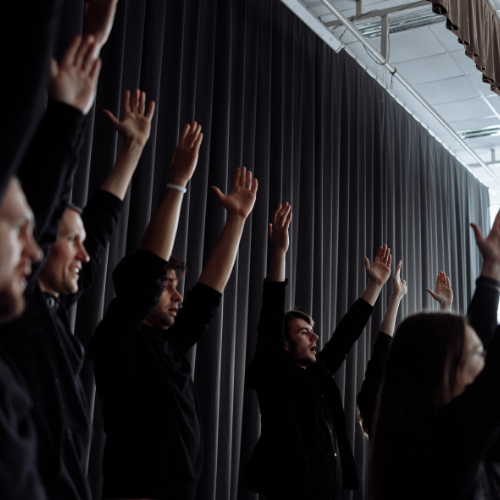
2.Body Resistance: Incorporating resistance into your breath training. Begin by taking a deep breath and, simultaneously, bending your knees slightly to assume a half-squat position. As you do this, raise your hands upward on both sides of your thorax, moving them up to the level of your diaphragm. Then, exhale on a fricative sound or while singing 'm.' While exhaling, lower your hands toward the floor, imagining that your hands are pushing down against a substance, much like water while you rise back up from your half-squat position. When you've exhaled completely allow the air to flow in naturally by opening your mouth. This exercise engages your deep abdominal muscles and your back muscles.
Expert Q&A with vocalist, composer, and voice coach Laura Stavinoha. Writer of the book Voice: A multifaceted approach to self-growth and vocal empowerment.
“We should not forget that it's just wonderful to sing for your own enjoyment (...).”
Can you tell us about your background and how it has influenced your approach to supporting singers?
From a young age, I’ve had a desire for music in my life and a strong drive to sing. This is what I enjoyed most as a child, what people said I was good at, and what I aspired to do for a living. I have however been rejected many times because of my voice, especially at formal higher education for singers. Consequently, I lost confidence about my voice and instead aimed for a career behind the scenes in music. Nevertheless, I always kept on singing, everyday. One thing led to another, and gradually I was building a career as a classical singer - and later as singer-songwriter - next to my day job. This was not an easy path though. Because of the earlier rejections I was trying hard to prove myself and suffered from performance anxiety, which affected my voice badly. Nowadays, I have found ways to deal with stage fright successfully, and I am excited to share these strategies with my vocal students and the rest of the world.
What are your golden nuggets of wisdom for singers who want to develop?
When it comes to singing, the media mainly presents us talent shows and major pop stars. We often only see an artist’s success, and not what happened beforehand: the hard work and the setbacks. Consequently, singing becomes more and more professionalized, something you are only allowed to do when you are ‘good’. We should not forget that it's just wonderful to sing for your own enjoyment. Singing is primarily a great way to regulate your emotions, connect with others and express your creativity. In this process, it doesn't always have to be beautiful or flawless. And if you aspire to become a better singer, professionally or not, know that this - of course - takes time and practice, but also introspection. To find your voice, you have to look for the blockades in yourself that you have built against expressing yourself freely.
What are the most important lessons you have learned about (singing) voice?
Your voice reflects your inner world, whether you want this or not. From science we now know that the autonomic nervous system controls the muscles around the voice box. Autonomic responses such as fight and flight will make you tense up your throat muscles, without you having conscious control over it. This makes it much harder to articulate, resonate and find the right intonation. It is the main reason your voice reveals when you are nervous, stressed or otherwise emotionally moved. It also means that you can have a talent for music and singing, but still struggle with intonation, loudness, and resonance. Consequently, if your voice does not sound good, clear, and free, it cannot always be solved with training vocal technique. Sometimes, in order to solve vocal problems, you need to address the nervous system first: develop body awareness, regulate emotions and deal with unhelpful thoughts.
Learn more about Laura’s work on her website www.useyourvoice.nl
Book: Voice: A multifaceted approach to self-growth and vocal empowerment
Until next time, keep singing! Esther/October 2023